

Table of Contents
- What Makes a Cold Brew Maker Actually Durable
- Glass vs Stainless Steel: Which Cold Brew Maker Lasts Longer?
- Cold Brew Coffee Maker vs Cold Drip: Which Suits Your Kitchen?
- Low Acidity Coffee Beans for Cold Brew: What to Look For
- How Long Does Cold Brew Last in the Fridge?
- Repairability and Spare Parts: The Test Most Reviews Skip
- Frequently Asked Questions
Last Updated: September 11, 2026
What Makes a Cold Brew Maker Actually Durable
A durable cold brew maker for home is one built from borosilicate glass or stainless steel, with a metal or reusable mesh filter, a properly seated airtight seal, and a body that resists cracking through repeated temperature swings. Most units fail at the seal or the carafe, not the brewing mechanism.
That matters because cold brew has moved from novelty to routine. Retailers and home-barista communities report steady growth in cold brew equipment sales as more households brew overnight rather than queue at a café. This guide from Brew & Glow cuts through the spec sheets and focuses on the one question most reviews avoid: will it still work in three years?
Cold brew is the process of steeping coarse-ground coffee in cold or room-temperature water for 12 to 24 hours to produce a smooth, low-acid concentrate (peer-reviewed research). The equipment you choose determines how clean that concentrate pours, how long it keeps, and how often you replace the whole thing.
Here's what most guides get wrong: they rank makers by cup quality in week one. Durability is decided by materials, seals, and whether replacement parts exist. Below, we break down the five factors that separate a maker that lasts from one that leaks by month eight.
Glass vs Stainless Steel: Which Cold Brew Maker Lasts Longer?
Stainless steel lasts longer against impact, but borosilicate glass resists flavour retention and staining far better. For a maker that sits on the counter and gets hand-washed daily, borosilicate is the more durable choice for taste; steel is the more durable choice for clumsy kitchens.
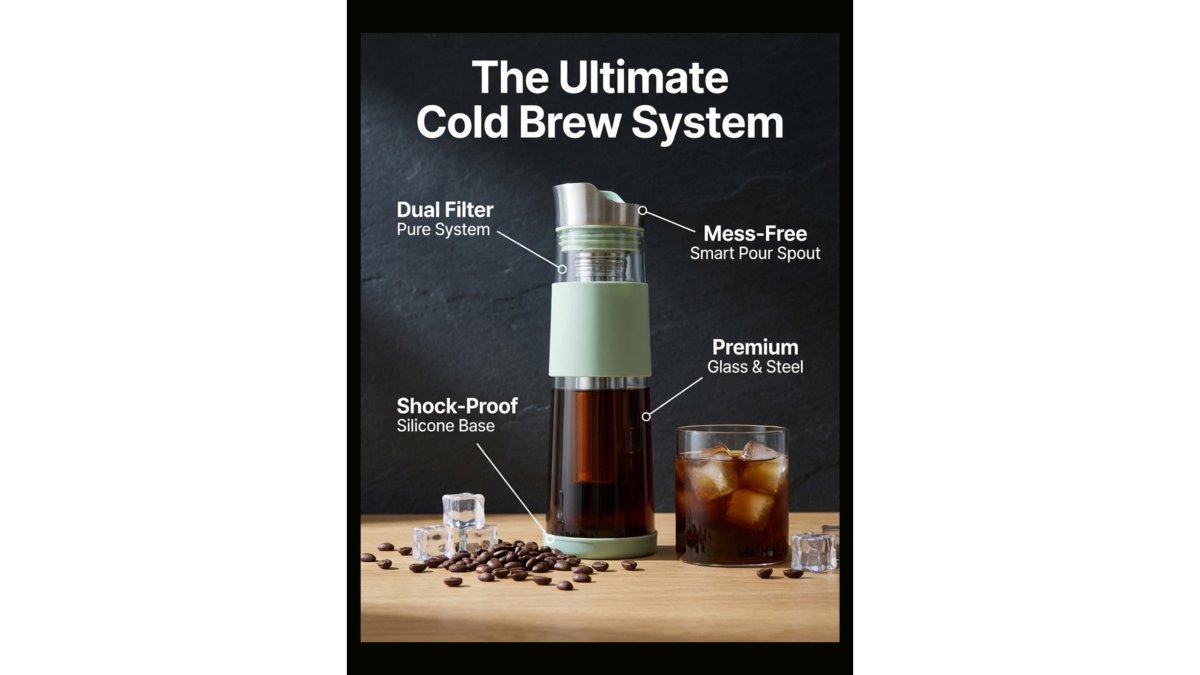
The trade-off comes down to three failure modes:
- Thermal shock: Borosilicate glass handles temperature swings without cracking (corning.com). Standard soda-lime glass does not, which is why cheap carafes fail after a hot rinse.
- Flavour carry-over: Stainless steel can hold onto oils from previous brews if the gasket isn't cleaned properly. Glass rinses clean.
- Impact damage: Steel dents rather than shatters, but a dented spigot housing can leak permanently.
A maker that combines borosilicate glass with stainless steel hardware covers both weaknesses. Brew & Glow's Brew and Go uses exactly that pairing, with a shockproof silicone base to absorb knocks on a stone benchtop.

Cold Brew Coffee Maker vs Cold Drip: Which Suits Your Kitchen?
A cold brew coffee maker uses immersion brewing, steeping grounds fully in water, while a cold drip tower passes water slowly through a bed of coffee over several hours. Immersion is simpler, cheaper, and easier to clean. Cold drip produces a brighter, more delicate cup but demands more countertop space and attention.
The difference is mechanical, not just stylistic. In an immersion maker, the entire coffee bed is submerged, so extraction happens evenly across the whole dose. In a cold drip tower, water travels through a narrow valve, drips onto a small puck of coffee, and percolates down through a bed of grounds. That percolation path is where the flavour difference comes from: the water picks up aromatic compounds in sequence rather than all at once, which is why drip towers tend to taste tea-like and layered.
Factor |
Cold Brew Coffee Maker |
Cold Drip Tower |
|---|---|---|
Method |
Immersion brewing |
Slow drip / percolation |
Time |
12-24 hours |
3-8 hours |
Countertop space |
Compact, fits under most overhead cupboards |
Tall, needs 40-60 cm of clearance |
Cleaning |
Rinse filter, wash carafe |
Multiple chambers, valve, drip tip, filter screen |
Flavour profile |
Smooth, chocolatey, low-acid |
Bright, tea-like, delicate |
Grind |
Coarse, raw-sugar texture |
Medium-coarse, slightly finer than immersion |
Failure points |
Seal, carafe, spigot |
Valve clogging, glass fragility, gasket wear |
Best for |
Most home kitchens |
Enthusiasts chasing clarity |
For a busy household, immersion wins on practicality. The overnight brewing window means you set it up before bed and pour in the morning. Cold drip requires monitoring the drip rate, most towers need the valve adjusted to roughly one drip per second, and a clogged valve or a shift in water level changes that rate overnight. The glass towers are also more fragile and harder to source parts for, and the multi-chamber design means more gaskets and seals that can degrade.
If you want a low-acid, sediment-free result without babysitting a drip valve, a well-sealed immersion maker with double filtration is the more durable, lower-maintenance choice. The trade-off is that immersion gives you less control over extraction nuance; you adjust by grind and time, not by drip rate. For most home brewers, that is a feature, not a limitation.
Low Acidity Coffee Beans for Cold Brew: What to Look For
Low acidity coffee beans for cold brew are typically medium to dark roasts from Brazil, Sumatra, or Colombia, or any bean processed with a Swiss water decaffeination method. Cold brewing already reduces perceived acidity, so bean choice is about flavour, not just stomach comfort.
Three things to check on the bag:
- Roast level: Darker roasts carry fewer of the bright, sharp acids found in light roasts. Medium-dark is the sweet spot for cold brew.
- Origin and process: Natural and honey-processed beans tend to taste sweeter and rounder. Washed beans taste cleaner and brighter.
- Decaffeination method: Swiss water processing removes caffeine without chemical solvents, which suits anyone avoiding solvent residue.
Grind matters just as much. Cold brew needs a coarse grind, roughly the texture of raw sugar. Too fine and you get sediment and a bitter, over-extracted concentrate. Too coarse and the brew tastes watery.
Brew & Glow sources its beans responsibly and roasts for cold brew specifically, including a Swiss water decaf option for anyone who wants the ritual without the caffeine.
How Long Does Cold Brew Last in the Fridge?
Cold brew lasts five to seven days in the fridge when stored in an airtight container. Once diluted with water or milk, drink it within three days. Oxidation is what turns it bitter, not bacteria alone.
Most guides stop there. But shelf life is not just a storage rule; it is a direct test of your maker's seal. A carafe with a worn gasket, a loose lid, or a spigot that does not close fully will let oxygen in continuously, and the concentrate will taste flat within 48 hours even though the calendar says you have a week. That is the durability angle almost no review covers: the seal is a wear part, and its condition determines how long your brew actually keeps.
Storage rules that extend shelf life:
- Keep it in a glass or stainless steel container with an airtight seal. Plastic absorbs odours and lets oxygen in.
- Store concentrate undiluted and dilute per glass. Concentrate holds its flavour profile far longer.
- Keep it at the back of the fridge, not the door, where temperature stays stable.
- If it tastes flat or sour, it has oxidised. Discard it.
- Check the gasket every few months. A gasket that has gone hard, cracked, or lost its shape will not seal, no matter how tightly you screw the lid.
A maker with a proper airtight seal and a spigot mechanism lets you pour straight from the fridge without opening the whole vessel, which limits oxygen exposure every time you serve. That is a genuine durability advantage: fewer lid removals means less wear on the seal and slower oxidation of the concentrate.
This is also where repairability and shelf life intersect. If the manufacturer sells replacement gaskets, a $10 part restores the seal and extends both the maker's life and the brew's fridge life. If they do not, a failed gasket turns the whole unit into a slow-oxidising container you will eventually replace.
Repairability and Spare Parts: The Test Most Reviews Skip
Repairability is the most reliable predictor of long-term value, and almost no review covers it. A maker with replaceable gaskets, filters, and spigots can run for years. A sealed unit with glued components becomes landfill the moment one part fails.
Ask these questions before buying:
- Can I buy a replacement gasket or seal separately?
- Is the filter reusable, or does it require disposable paper filters?
- Are the glass carafe and spigot sold as spare parts?
- Does the manufacturer publish cleaning and reassembly instructions?
Reusable stainless steel mesh filters and borosilicate carafes are the two components most worth checking for spares. Gasket integrity is the most common point of failure, and a maker that sells cheap replacement gaskets turns a $10 fix into years of extra service rather than a full replacement.
This is also where sustainability and waste impact converge. A repairable, plastic-free maker with a reusable filter produces no ongoing consumable waste, which matters to anyone trying to cut single-use paper filters from their routine.
Choosing a durable cold brew maker for home comes down to materials, seals, and whether you can repair it rather than replace it. Most makers look identical on the shelf; only a few survive three years of daily use. Brew & Glow built the Brew and Go around that problem, with borosilicate glass and stainless steel construction, a patented pour mechanism for clean, sediment-free serving, a shockproof silicone base, and double filtration that keeps grounds out of your glass. Paired with responsibly sourced, low-acidity beans, it turns a rushed morning into a ritual worth keeping. Shop the ritual and brew café-quality cold brew at home for around $2 a glass.
Frequently Asked Questions
Is a glass or stainless steel cold brew maker more durable?
Both materials last well when cared for properly. Borosilicate glass resists thermal shock and does not hold onto flavours or odours, but it can crack if dropped. Stainless steel survives knocks better and stays cold longer, though lower-grade steel can pick up a metallic taste over time. Look for thick borosilicate glass paired with a stainless steel mesh filter for the best balance of durability and clean taste.
How long does cold brew last in the fridge?
Homemade cold brew concentrate keeps for up to two weeks in a sealed container in the fridge, while ready-to-drink cold brew is best within three to five days. An airtight seal matters more than the container material. Oxidation is what turns cold brew bitter and stale, so a maker with a proper gasket lid will keep your brew smooth for longer.
What is the difference between a cold brew coffee maker and a cold drip tower?
A cold brew coffee maker uses immersion brewing, where coffee grounds steep in water for 12 to 24 hours before you filter them out. A cold drip tower drips water slowly over a bed of grounds, which takes three to eight hours and produces a lighter, more tea-like cup. Immersion makers are simpler to clean and easier to fit on a countertop.
Do low acidity coffee beans make a difference for sensitive stomachs?
Yes. Cold brew already extracts less acid than hot brewing because heat pulls out more of the compounds that irritate the stomach. Choosing low acidity coffee beans for cold brew, such as beans processed with the Swiss water method, reduces it further. People with reflux often find cold brew gentler, though individual results vary.


