
Table of Contents
- Why Look Beyond Toddy for Your Cold Brew Setup
- Plastic-Free Cold Brew Makers: The Case for Glass and Stainless Steel
- Full Immersion Brewing: Understanding the Method
- How to Make Cold Brew at Home Without Plastic
- Low-Acidity Cold Brew Beans for Sensitive Stomachs
- Long-Term Maintenance Costs and Durability
- Environmental Impact: Why Plastic-Free Matters
- Conclusion
Last Updated: August 28, 2026
Why Look Beyond Toddy for Your Cold Brew Setup
The cold brew market has evolved dramatically. What started as a niche brewing method is now mainstream, and alternatives to Toddy cold brew makers have emerged that address real pain points the original design never solved. At Brew & Glow, we've analysed what coffee enthusiasts actually want: durability, sustainability, and brewing quality without compromise.

Traditional plastic-based brewers absorb odours, can leach compounds over time, and degrade with repeated use. If you're investing in daily-use equipment for years, the material matters more than most people realise.
This guide explores compelling alternatives to Toddy cold brew makers, focusing on glass and stainless steel construction. We'll break down what makes each approach different, how they handle full immersion brewing, and why plastic-free equipment is worth considering for anyone serious about their morning ritual.
Plastic-Free Cold Brew Makers: The Case for Glass and Stainless Steel
The fundamental difference between plastic and glass or stainless steel comes down to longevity and purity.
Glass construction benefits
Borosilicate glass withstands temperature shock and daily handling without cracking. Unlike standard glass, it won't fracture when moving from fridge to counter. The material is completely inert, it won't interact with your coffee's delicate compounds or absorb flavours from previous brews.
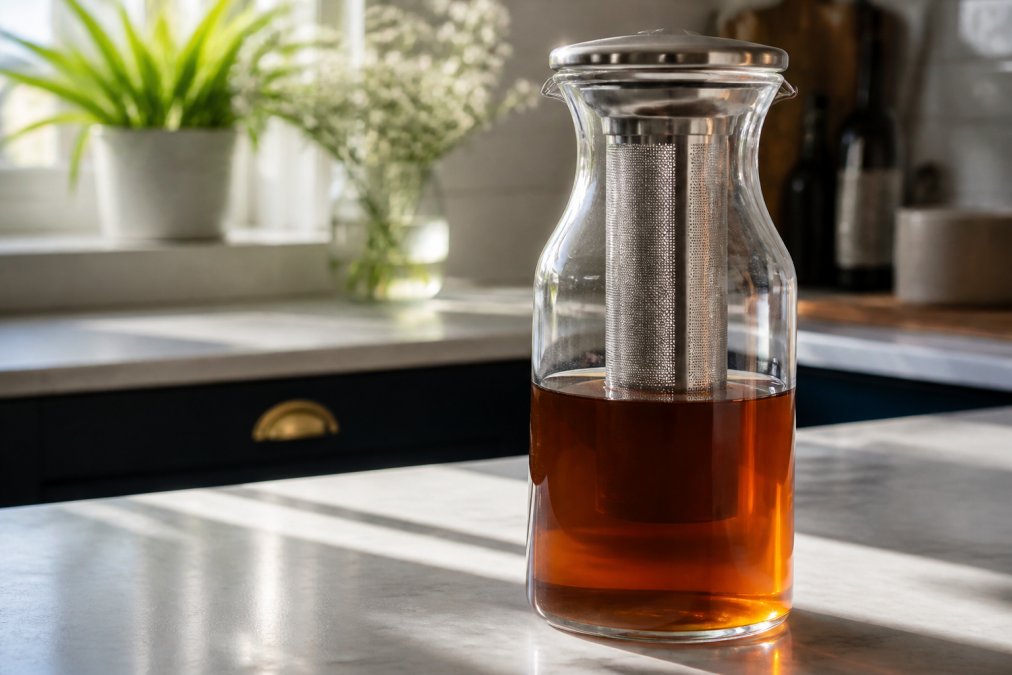
A glass brewing vessel looks intentional on your countertop and signals that your morning routine matters. For design-focused homeowners, this transforms a functional tool into displayable kitchen equipment.
Cleaning is straightforward: glass doesn't stain and won't hold coffee residue the way plastic does. After months of use, your glass brewer looks as clean as day one.
Stainless steel durability
Stainless steel offers different advantages, particularly for portability and robustness. A stainless steel brewing vessel won't break if dropped and maintains consistent temperature better than glass during steeping.
Double-wall construction in premium stainless steel models provides insulation that keeps your cold brew concentrate at an ideal temperature throughout extraction. This thermal stability improves extraction consistency, coffee grounds steep in a more controlled environment.
Stainless steel requires minimal maintenance and won't scratch easily. The trade-off is you can't see your brew developing inside the vessel, so you work more on timing and feel rather than visual cues.
Full Immersion Brewing: Understanding the Method
Full immersion brewing is the foundation of all cold brew extraction. Unlike drip methods where water passes through grounds once, full immersion means your coffee grounds sit completely submerged in cold water for an extended period. This slow process extracts soluble compounds while leaving behind compounds that create bitterness and high acidity.
The steeping process works through osmosis and diffusion. Water molecules gradually penetrate coffee grounds, dissolving flavour compounds, oils, and caffeine. Because the water is cold, extraction happens slowly, typically 12 to 24 hours depending on grind size and coffee-to-water ratio.
Cold brew concentrate contains fewer tannins and acidic compounds than hot-brewed coffee that's been cooled (peer-reviewed research). For people managing acid reflux or digestive sensitivity, this is chemistry, not marketing. The beauty of full immersion is its simplicity: a glass jar, coarse grounds, cold water, and time produce excellent results.
How to Make Cold Brew at Home Without Plastic
Making cold brew at home is straightforward once you understand the critical variables: coffee-to-water ratio, steeping time, and filtration method.
Setting your coffee-to-water ratio
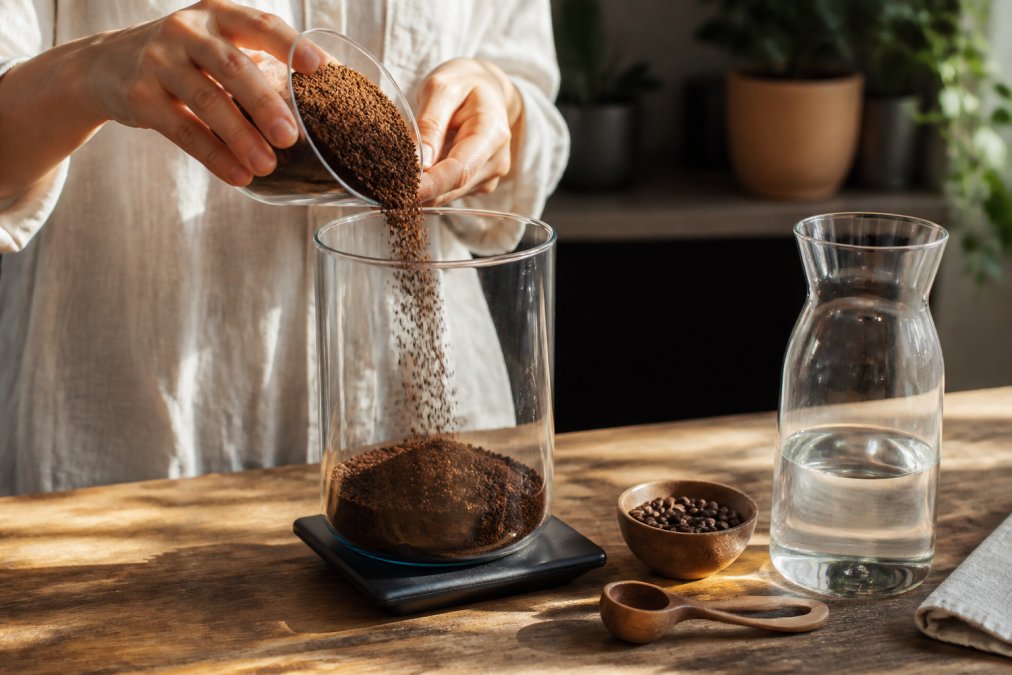
The coffee-to-water ratio determines your concentrate's strength. A common starting point is one part coffee to four parts water by weight (peer-reviewed research). Using a kitchen scale, measure your coffee grounds first, then add water at four times that weight. For example, 200 grams of coarse grounds to 800 grams of cold water creates a balanced concentrate.
Some prefer a stronger concentrate (one to three ratio) if diluting significantly with milk or water. Others go lighter (one to five ratio) for a more delicate flavour profile.
Steeping time and extraction
The steeping period typically runs between 12 and 24 hours (peer-reviewed research). Shorter steeps (12 hours) produce lighter, tea-like cold brew. Longer steeps (20-24 hours) extract more deeply, creating richer concentrate with fuller body.
Temperature matters significantly. Warm kitchens accelerate extraction; you might reach optimal extraction in 16 hours instead of 20. Cooler environments may need the full 24 hours. Most people underbrew initially because they're impatient. Give it the full time, don't pull it early.
Avoid over-steeping beyond 24 hours. You risk extracting undesirable compounds that create harsh, astringent flavours.
Troubleshooting common extraction problems
Weak or thin-tasting cold brew signals under-extraction. The most common cause is insufficient steeping time. Solution: extend your next batch to the full 24 hours. A secondary cause is grind size; if coffee is ground too fine, water can't penetrate evenly. Use a coarse grind similar to French press consistency. If already using coarse grounds and steeping for 24 hours, increase your coffee-to-water ratio from 1:4 to 1:3.5.
Bitter or harsh cold brew indicates over-extraction. This happens when steeping exceeds 24 hours or when water temperature is warmer than intended. Cold brew left on a sunny windowsill can over-extract in 18 hours. Solution: brew in a cool, dark place (your fridge is ideal) and stick to a maximum 24-hour steep. If bitterness persists with correct timing, your grind may be too fine; switch to coarser grounds.
Flat or muted flavour despite correct steeping and ratio usually points to stale beans or incorrect water quality. Coffee loses volatile aromatic compounds within two weeks of roasting. Use beans roasted within the past two weeks. Heavily chlorinated or mineral-heavy water can mask delicate flavours; filtered or bottled water often produces noticeably better results.
Inconsistent results between batches usually stems from variable steeping time or temperature fluctuation. Solution: use a timer and keep your brewing vessel in a consistent location (your fridge is best). If brewing on the counter, ambient temperature swings can shift extraction by several hours.
Filtration and cleanup
Paper filtration removes all sediment and oils, creating a clean, bright cup. Metal mesh filters allow some oils through, producing fuller mouthfeel. Cloth filters sit somewhere in between.
The Brew & Glow cold brew maker uses double stainless steel filtration, which eliminates sediment completely while preserving the coffee's natural oils and body. This hybrid approach gives you a sediment-free pour without the thinness that paper filtration can sometimes create.
Cleanup depends on your filtration method. Paper filters require disposal. Metal and cloth filters need immediate rinsing; dried coffee grounds stuck to mesh are difficult to remove later. Stainless steel mesh is easier to clean than cloth, which can retain coffee oils and require occasional deep cleaning.
Low-Acidity Cold Brew Beans for Sensitive Stomachs
The coffee beans you choose matter as much as your brewing method. Low-acidity cold brew beans are typically sourced from specific regions and processed in ways that naturally reduce acid compounds. Indonesian and Brazilian coffees tend toward lower acidity profiles than East African coffees. Natural and honey-processed beans often have different acid levels than washed coffees.
Brew & Glow sources responsibly grown, low-acidity beans specifically selected for cold brew preparation. Our beans are roasted to bring out smooth, rounded flavours while minimising sharp, acidic notes that trigger sensitivity. The combination of our brewing equipment and bean selection creates a genuinely gentler coffee experience.
For people with sensitive stomachs, the difference is tangible. Many customers report enjoying cold brew without the discomfort that hot coffee creates. This isn't because cold brew is inherently less acidic, it's because full immersion extraction removes fewer problematic compounds, and our bean selection starts with a lower acid foundation.
Long-Term Maintenance Costs and Durability
The upfront cost of a premium cold brew maker often concerns people, but the long-term calculation tells a different story.
The true cost of plastic brewers
A plastic brewer might cost less initially, but economics deteriorate quickly. Plastic brewing vessels typically remain functional for two to three years before degradation becomes noticeable: discolouration, odour absorption, and micro-scratches that harbour bacteria and staining.
Plastic brewers often use proprietary paper filters. If your brewer requires specific filter sizes or shapes, you're locked into purchasing replacement filters regularly. Over three years, filter costs accumulate significantly, on top of replacing the brewer itself.
As plastic degrades, it can impart subtle flavours to your brew and absorb oils from previous batches, affecting taste quality. Many users respond by upgrading to a new brewer sooner than necessary, accelerating the replacement cycle.
Glass and stainless steel: the long-term investment
A quality glass or stainless steel brewer represents a single investment that lasts five to ten years or longer. You're not replacing filters regularly (if you use reusable mesh or cloth), you're not upgrading to a new model every couple of years, and you're not dealing with the slow degradation that plastic equipment experiences.
Glass brewers with reusable stainless steel mesh filters eliminate the filter replacement cost entirely. Rinse and dry your mesh after each use, and it lasts indefinitely. Stainless steel brewers offer similar economics. A double-wall stainless steel brewer with a reusable mesh filter has virtually no consumable costs.
Maintenance requirements and real costs
Maintenance is minimal with quality equipment.
Glass brewers: Rinse your filter after each use (30 seconds), wash the brewing vessel with warm soapy water monthly (5 minutes). No special cleaning solutions required. Borosilicate glass won't scratch or stain. Total annual maintenance time: roughly 3-4 hours.
Stainless steel brewers: Rinse your filter after each use (30 seconds), wash the vessel monthly (5 minutes). Occasionally (every 6-12 months), use a soft cloth to buff the exterior to maintain appearance. Total annual maintenance time: roughly 3-4 hours.
Plastic brewers: Rinse your filter after each use (30 seconds), wash the vessel weekly (10 minutes). Replace filters regularly. Every 2-3 years, replace the entire brewer. Total annual maintenance time: roughly 8-10 hours.
The 10-year cost comparison
Over a decade, the financial case for glass or stainless steel becomes stark. A plastic brewer requires multiple replacements and ongoing filter purchases, while a glass or stainless steel brewer with reusable mesh requires no consumable replacements. The glass or stainless steel option costs roughly one-sixth as much over a decade, even accounting for the higher upfront investment.
Beyond economics, equipment that doesn't degrade means your brew quality remains consistent. You're not chasing flavour problems caused by worn plastic or dealing with the frustration of replacing equipment every few years. This reliability has a psychological value that matters in daily life.
Environmental Impact: Why Plastic-Free Matters
The environmental argument for plastic-free brewing equipment goes beyond obvious waste reduction. Plastic brewing vessels end up in landfills or recycling streams after a few years. Glass and stainless steel are infinitely recyclable and don't degrade in quality through recycling cycles.
Glass production requires high heat but creates an inert, stable product. Plastic production relies on fossil fuels and creates a material that persists in the environment for centuries. From a lifecycle perspective, glass and stainless steel are substantially lower-impact choices.
Choosing a plastic-free brewer signals a commitment to mindful consumption and durable goods over disposable culture. For environmentally conscious consumers, this alignment between values and purchasing decisions matters. The water usage and chemical exposure associated with plastic manufacturing are real environmental costs that don't appear on a price tag.
The shift from plastic-based cold brew makers to glass and stainless steel alternatives represents more than a material change, it's about prioritising durability, purity, and intentionality in your daily ritual. Whether you're drawn to the aesthetic clarity of glass or the robustness of stainless steel, the alternatives to Toddy cold brew makers offer meaningful improvements in longevity, environmental impact, and brewing consistency.
Brew & Glow's cold brew maker combines borosilicate glass and double stainless steel filtration to deliver sediment-free, smooth cold brew without any plastic components. Paired with our low-acidity, responsibly sourced beans, it transforms your morning into a genuine moment of self-care. Shop the ritual and experience the difference quality equipment makes.
=== FAQ ANSWERS (audit these too, same rules) ===
[1] Q: What makes plastic-free cold brew makers better than the Toddy system? A: Plastic-free makers using borosilicate glass and stainless steel eliminate chemical leaching and deliver a cleaner taste profile. Glass is inert, so it won't absorb odours or flavours, and stainless steel mesh filters provide superior durability. Unlike plastic vessels, these materials won't degrade over time or release compounds into your brew, ensuring a sediment-free, pure cold brew concentrate every time.
[2] Q: How long does it take to make cold brew at home without plastic equipment? A: Full immersion cold brew typically requires 12 to 24 hours of steeping time, depending on your coarse grind size and coffee-to-water ratio. Once steeped, filtration through stainless steel mesh takes just a few minutes. The process is hands-off during brewing, making it ideal for busy professionals who want cafe-quality results without active involvement. Refrigeration extends shelf life, keeping your concentrate fresh and smooth for up to two weeks.
[3] Q: Do low-acidity cold brew beans actually reduce stomach sensitivity? A: Cold brewing naturally reduces acidity by up to 70% compared to hot coffee because the steeping process extracts fewer tannins and acidic compounds. Low-acidity beans sourced from specific origins and processed responsibly further minimise stomach irritation. Many users with sensitive stomachs report noticeably smoother, gentler brews. The combination of full immersion brewing with quality, low-acidity beans creates a brew that's significantly easier on digestion than conventional methods.
[4] Q: Is investing in a premium plastic-free cold brew maker worth the cost? A: Premium makers using borosilicate glass and stainless steel last years longer than plastic alternatives, eliminating replacement costs. They brew sediment-free, cafe-quality cold brew consistently, reducing waste from failed batches. When paired with responsibly sourced, low-acidity beans, the ritual becomes a daily self-care practice rather than just caffeine consumption. The durability, aesthetic appeal, and superior brewing results justify the initial investment for anyone serious about their morning routine.
Frequently Asked Questions
Q: What makes plastic-free cold brew makers better than the Toddy system?
A: Plastic-free makers using borosilicate glass and stainless steel eliminate chemical leaching and deliver a cleaner taste profile. Glass is inert, so it won't absorb odours or flavours, and stainless steel mesh filters provide superior durability. Unlike plastic vessels, these materials won't degrade over time or release compounds into your brew, ensuring a sediment-free, pure cold brew concentrate every time.
Q: How long does it take to make cold brew at home without plastic equipment?
A: Full immersion cold brew typically requires 12 to 24 hours of steeping time, depending on your coarse grind size and coffee-to-water ratio. Once steeped, filtration through stainless steel mesh takes just a few minutes. The process is hands-off during brewing, making it ideal for busy professionals who want cafe-quality results without active involvement. Refrigeration extends shelf life, keeping your concentrate fresh and smooth for up to two weeks.
Q: Do low-acidity cold brew beans actually reduce stomach sensitivity?
A: Cold brewing naturally reduces acidity by up to 70% compared to hot coffee because the steeping process extracts fewer tannins and acidic compounds. Low-acidity beans sourced from specific origins and processed responsibly further minimise stomach irritation. Many users with sensitive stomachs report noticeably smoother, gentler brews. The combination of full immersion brewing with quality, low-acidity beans creates a brew that's significantly easier on digestion than conventional methods.
Q: Is investing in a premium plastic-free cold brew maker worth the cost?
A: Premium makers using borosilicate glass and stainless steel last years longer than plastic alternatives, eliminating replacement costs. They brew sediment-free, cafe-quality cold brew consistently, reducing waste from failed batches. When paired with responsibly sourced, low-acidity beans, the ritual becomes a daily self-care practice rather than just caffeine consumption. The durability, aesthetic appeal, and superior brewing results justify the initial investment for anyone serious about their morning routine.
This article was written using GrandRanker


