
Table of Contents
- Why Your Cold Brew Tastes Bitter
- Cold Brew Steep Time and Over-Extraction
- Cold Brew Grind Size Guide for Smooth Flavour
- Water-to-Coffee Ratios and Extraction Balance
- Best Coffee Beans for Cold Brew
- How to Fix Bitter Cold Brew: Practical Solutions
- Preventing Bitterness in Future Brews
- Conclusion
Last Updated: August 27, 2026
Why Your Cold Brew Tastes Bitter
Bitter cold brew is one of the most frustrating brewing mistakes, and it's almost always preventable. The culprit isn't mysterious, it's over-extraction, which happens when coffee grounds steep too long or in the wrong conditions, releasing excessive bitter compounds into your brew.
Cold brew differs fundamentally from hot brewing. Because there's no heat to speed up extraction, the process relies entirely on time and contact between water and grounds. Get the variables wrong, and you end up with a cup that tastes harsh, astringent, or unpleasantly sharp instead of smooth and balanced.
The good news: fixing bitter cold brew comes down to understanding a few core variables. Steep time, grind size, water-to-coffee ratio, bean quality, and even your equipment all play a role. At Brew & Glow, we've spent considerable time perfecting the cold brew process.

Below, we'll walk you through each factor that causes bitterness and show you exactly how to correct it, whether you're troubleshooting an existing problem or preventing one from the start.
Cold Brew Steep Time and Over-Extraction
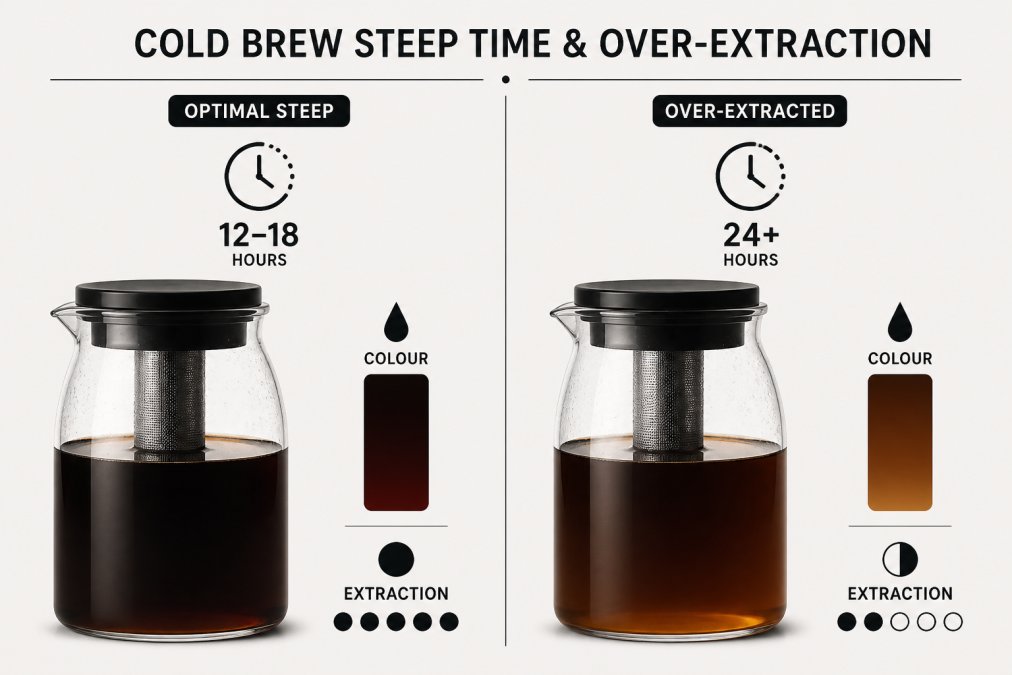
The most common reason cold brew tastes bitter is that it's steeped too long. Many people assume "cold brew" means you can just leave grounds in water indefinitely, but that's incorrect. Over-extraction happens when grounds remain in contact with water beyond their optimal extraction window.
During steeping, soluble compounds dissolve from the coffee grounds into the water in a specific sequence (peer-reviewed research). The desirable flavours extract first, the bright acidity, sweetness, and complexity. But if steeping continues too long, bitter compounds like tannins and chlorogenic acid leach out, overwhelming the cup.
The ideal steep time for most cold brew is between 12 and 24 hours (peer-reviewed research). Anything beyond 24 hours almost guarantees bitterness, especially if your grind size is coarse or your water-to-coffee ratio is tight. If you've been steeping for 36 hours or more, that's your problem right there.
What complicates this is that steep time interacts with other variables. A finer grind extracts faster, so it needs less time. A higher coffee-to-water ratio also accelerates extraction. Temperature matters too, if your brew sits at room temperature for part of the steeping period, extraction speeds up compared to a consistently cold environment.
The practical fix: start with 18 hours of steeping in a consistently cold environment (your refrigerator). Taste the result. If it's still bitter, reduce to 16 hours next time. If it's sour or under-extracted, extend to 20 hours. This narrow window, 16 to 20 hours, is where most excellent cold brew lives.
Cold Brew Grind Size Guide for Smooth Flavour
Grind size is the second-most critical variable in preventing bitter cold brew. The coarser your grind, the slower extraction happens. The finer your grind, the faster it happens. Get this wrong, and steep time alone won't save you.
For cold brew, a coarse grind is essential. Think sea salt or breadcrumbs, particles large enough that you can see individual pieces, not a fine powder. A coarse grind slows the rate at which soluble compounds dissolve, which gives you more control over extraction and reduces the risk of pulling out those harsh, bitter compounds too quickly.
Many people use a medium-coarse grind and then wonder why their cold brew tastes bitter after just 18 hours. The finer particles extract faster, and by hour 18, you've already pulled out too many bitter compounds. If you grind too fine, you're essentially forcing cold brew to behave like hot brewing, rapid extraction that doesn't suit the cold immersion method.
The reason grind size matters so much is surface area. Finer particles have more surface area exposed to water, so extraction accelerates. A coarse grind minimises this effect, which is exactly what you want in cold brewing. You're aiming for slow, controlled extraction over many hours.
Here's a practical test: if your cold brew tastes bitter even after reducing steep time, your grind is probably too fine. Switch to a noticeably coarser grind and keep everything else constant. You'll often find the bitterness disappears immediately.
Water-to-Coffee Ratios and Extraction Balance
The ratio of water to coffee grounds directly affects extraction rate and flavour intensity. Too much coffee relative to water, and you'll extract faster and risk over-extraction. Too much water, and you might under-extract, leaving your brew sour or weak.
The standard ratio for cold brew is 1:4 or 1:5 (one part coffee to four or five parts water by weight) (peer-reviewed research). This produces a concentrate that you typically dilute with water or milk before drinking. Some people prefer 1:3 for a stronger concentrate, but that tighter ratio requires careful attention to steep time, it's easier to over-extract.

If your cold brew tastes bitter, check your ratio first. If you've been using 1:3 and steeping for 20 hours, that's likely your culprit. The higher coffee concentration accelerates extraction, pulling out bitterness faster. Shift to 1:4 or 1:5, keep your steep time at 18 hours, and taste the difference.
Water quality also plays a subtle but real role here. Hard water (water with high mineral content) can slightly accelerate extraction compared to soft water. If you're in an area with very hard water and you're experiencing persistent bitterness, consider using filtered water for your cold brew. The mineral content in tap water can interact with coffee compounds in ways that emphasise bitterness.
The practical approach: start with 1:4 (50 grams of coffee to 200 millilitres of water, for example). Steep for 18 hours. Taste it. If it's bitter, don't immediately blame the ratio, check your grind size first. If the grind is clearly coarse and it's still bitter, then try 1:5 next time.
Best Coffee Beans for Cold Brew
The quality and origin of your beans matter significantly in cold brew, perhaps more than in hot brewing. Cold extraction is slower and gentler, which means it extracts different compounds than hot water does. Some beans shine in cold brew; others taste flat or overly bitter.
Light and medium roasts generally work better for cold brew than dark roasts. Dark roasts have already undergone significant heat treatment during roasting, which breaks down certain flavour compounds. When you then steep them cold for 18+ hours, you risk extracting what remains in a way that tastes harsh or one-dimensional.
Medium roasts offer a sweet spot: they've developed enough body and complexity to shine in cold brew, but they haven't lost the nuance that makes the cup interesting. Light roasts can work beautifully too, especially if the beans are fresh and the roaster has highlighted their origin characteristics.
Bean freshness is critical. Cold brew amplifies the flavour of stale beans in ways hot brewing can mask. If your beans are more than three weeks old, consider buying fresh ones before troubleshooting anything else. Stale beans often taste bitter or flat in cold brew, even when everything else is dialled in correctly.
Origin matters as well. Single-origin beans from specific regions often perform more predictably in cold brew than blends. If you're experimenting, try beans from Central America or East Africa first, these regions produce beans that typically taste smooth and balanced in cold extraction. Avoid very acidic origins (like some Ethiopian naturals) if you're already dealing with bitterness; they can make the problem worse.
Brew & Glow's responsibly sourced, low-acidity beans are specifically selected and roasted for smooth cold brew. The 70% reduction in acidity compared to standard beans means fewer harsh compounds to extract in the first place, which makes it genuinely harder to over-extract and end up with bitterness. If you've been struggling with bitter cold brew using generic supermarket beans, switching to beans designed for cold brewing often solves the problem immediately.
How to Fix Bitter Cold Brew: Practical Solutions
If you've already made a batch that tastes bitter, you have several options depending on how far gone it is.
The simplest fix is dilution. Bitter cold brew concentrate can often be rescued by adding more water or milk. This dilutes the bitter compounds and can make the cup drinkable. If your concentrate is very bitter, try a 1:2 ratio (one part concentrate to two parts water) instead of the usual 1:1. Yes, this weakens the coffee, but it's better than pouring it down the sink.
If dilution doesn't help, try adding a small pinch of salt. Salt can chemically mask bitterness by interfering with bitter taste receptors. A quarter-teaspoon in a 250-millilitre cup is enough, any more and you'll taste the salt instead. This is a last resort, but it works surprisingly well.
For future batches, implement these fixes in order:
1. Reduce steep time. Start at 16 hours instead of 18 or 20. Taste it. If it's still bitter, you've identified that steep time alone isn't the issue.
2. Switch to a coarser grind. If you're using a medium-coarse grind, go noticeably coarser. This is the single most impactful change most people can make.
3. Adjust your ratio. Move from 1:3 to 1:4 or 1:5. This slows extraction and gives you more margin for error.
4. Use fresher, higher-quality beans. Stale or low-quality beans are often the hidden culprit. Switching to beans roasted specifically for cold brew (like Brew & Glow's low-acidity options) eliminates variables and often solves bitterness immediately.
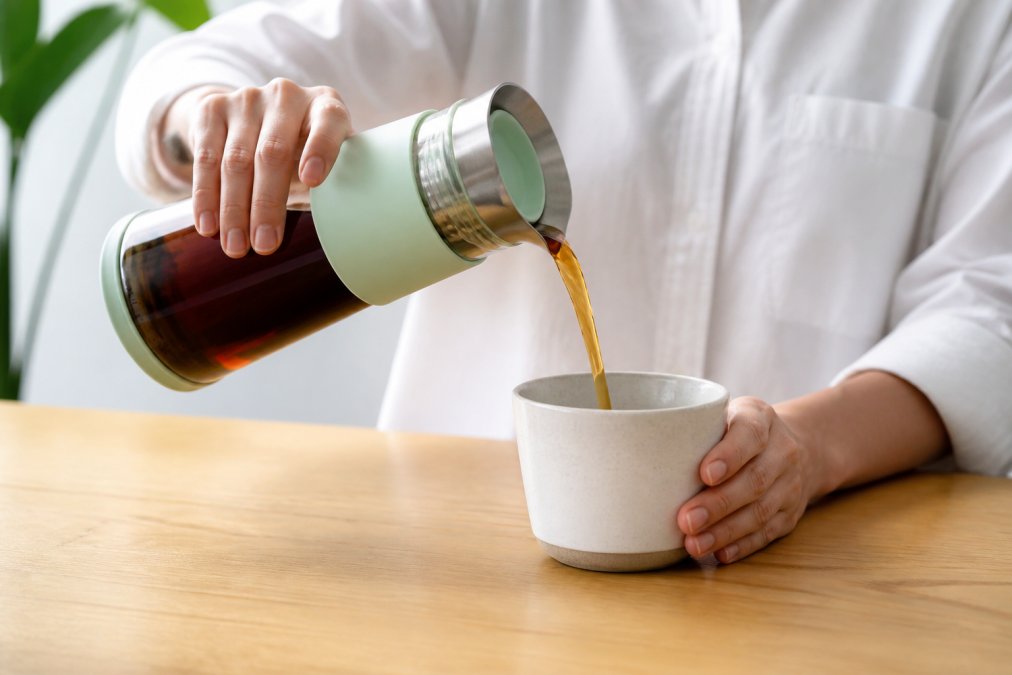
5. Check your equipment. If you're using a metal mesh filter, fine particles can slip through and make the final cup taste gritty or bitter. Switch to a paper filter or a dedicated cold brew maker with proper filtration. The Brew & Glow cold brew maker uses double stainless steel filtration, which ensures a clean, sediment-free pour every time, no bitter particles, no cloudiness.
Preventing Bitterness in Future Brews
Once you've fixed a bitter batch, the goal is to never make one again. Prevention is straightforward if you stick to these fundamentals.
Store your beans properly. Keep them in an airtight container away from light and heat. Buy only what you'll use within three weeks. Stale beans are a silent killer of cold brew quality.
Use cold water from the start. Room-temperature water extracts faster than cold water. Fill your brewer with cold water straight from the fridge or use filtered cold water. Keep the entire batch in the refrigerator during steeping, don't let it sit on the counter.
Invest in proper equipment. A dedicated cold brew maker with reliable filtration removes guesswork. The Brew & Glow cold brew maker is designed specifically for this, the patented pour mechanism ensures clean extraction without sediment, and the borosilicate glass construction is durable enough to last years. It's the last cold brew maker you'll ever need to buy.
Taste consistently. Keep notes on what works. Write down your steep time, grind size, bean origin, and how the result tasted. Over three or four brews, you'll identify your exact sweet spot. What works for someone else might not work for your water, your beans, or your taste preferences.
Don't assume longer is better. Cold brew isn't like wine, it doesn't improve indefinitely. Eighteen to 20 hours is the window where most cold brew reaches its peak. Beyond that, you're just extracting bitterness.
Conclusion
Bitter cold brew almost always comes down to one or more of these factors: steep time that's too long, grind size that's too fine, a ratio that's too concentrated, stale beans, or equipment that doesn't filter properly. Fix these variables in order, start with grind size and steep time, then adjust ratio and bean quality, and you'll eliminate bitterness.
The reason Brew & Glow's cold brew system works so consistently is that it addresses all of these at once. The low-acidity beans reduce the bitter compounds available to extract in the first place. The double-filtration system removes sediment that can taste harsh. The design encourages proper steep time and ratio by making the process foolproof. You get smooth, café-quality cold brew every single time, without the guesswork. Shop the ritual and transform your morning coffee into something genuinely worth savouring.
Frequently Asked Questions
How do I reduce bitterness in cold brew?
Reduce steep time to 12–16 hours instead of 24, use a coarser grind to slow extraction, and lower your water-to-coffee ratio slightly. If your brew is already bitter, dilute it with water or milk to mask harsh compounds. Bitter cold brew often comes from over-extraction, where too many tannins and chlorogenic acid dissolve into the liquid. Switching to higher-quality, lighter-roasted beans also helps, as darker roasts can release more bitter compounds during immersion brewing.
Does grind size affect cold brew bitterness?
Yes, significantly. A fine grind extracts too quickly, pulling excessive solubility and bitter compounds into the brew. A coarse grind slows extraction and produces a smoother, less astringent flavour. For cold brew, aim for a consistency similar to sea salt. If you're using pre-ground coffee, check the label—many commercial grinds are too fine for cold brewing and will taste bitter no matter your steep time or water ratio.
Can low-acidity coffee beans prevent bitterness?
Low-acidity beans can reduce sourness and harshness, but bitterness comes primarily from over-extraction and steep time, not acidity alone. That said, lighter roasts and specialty-grade arabica beans tend to have more refined flavour profiles with fewer harsh compounds than robusta or dark roasts. Brew & Glow's responsibly sourced beans are selected to minimise bitterness while delivering smooth, cafe-quality taste—and they're designed to work perfectly with the Brew and Go maker's double filtration system.
How long can cold brew stay fresh without becoming bitter or oxidised?
Properly brewed and filtered cold brew stays fresh for up to 14 days in an airtight glass container in the refrigerator. After that, flavour degrades and bitterness can intensify as the brew oxidises. Temperature fluctuations speed up this process, so keep your brew in a consistent, cool spot. Using a sealed glass maker like the Brew and Go prevents air exposure during storage, helping your cold brew maintain its smooth, sediment-free quality throughout the week.
This article was written using GrandRanker


