
Table of Contents
- Why Busy People Need a Low-Maintenance Cold Brew Maker
- What to Look For in a Cold Brew Maker When You're Short on Time
- Brew & Go: The Easiest Cold Brew Maker to Clean and Use
- OXO Cold Brew Maker Alternatives That Save You Time
- How to Make Cold Brew Coffee at Home in Under 5 Minutes
- Best Low-Acidity Coffee Beans for a Smooth, Gentle Brew
- Conclusion: Choose the Cold Brew Maker That Works as Hard as You Do
- Frequently Asked Questions
Last Updated: September 9, 2026
Why Busy People Need a Low-Maintenance Cold Brew Maker
A cold brew maker steeps coarse coffee grounds in cold water over 12 to 24 hours to produce a smooth, concentrated coffee (peer-reviewed research). For busy professionals, one batch delivers several days of cafe-quality coffee with zero daily effort. The catch is that many brewers turn cleaning into a second job, which defeats the purpose.
Most guides rank brewers by flavour output while treating cleanup as an afterthought. A brewer you avoid cleaning is a brewer you stop using.
Below, we show you how to choose a low-maintenance cold brew maker, compare the easiest options to clean, and walk through a five-minute brewing routine.
What to Look For in a Cold Brew Maker When You're Short on Time
When evaluating cold brew makers under time pressure, the specs that matter are not printed on the box. The four that determine your maintenance load are disassembly time, dishwasher compatibility, filter geometry, and part count.
Disassembly time is the single best predictor of long-term use. Time yourself breaking the brewer down and reassembling it. If that takes more than two minutes, you will skip the full clean more often than not. A brewer that comes apart into three pieces, carafe, lid, and filter, cleans dramatically faster than one with a dozen interlocking components. Brewers requiring under two minutes to disassemble are the ones that survive past the first month.
Dishwasher compatibility is not binary. Many manufacturers claim a brewer is dishwasher safe when only the carafe is, while the lid and filter basket must still be hand washed. Check the fine print on each component. For zero hand washing, look for a brewer where every component, including the filter mesh, is explicitly rated for dishwasher use.
Filter geometry determines your cleaning effort more than filter material. A fine mesh filter with a narrow surface area will clog within weeks, requiring careful scrubbing. A wide stainless steel mesh filter with an open structure rinses clean in seconds. The trade-off is sediment: wider mesh allows more fines through. Double filtration, a coarse mesh followed by a finer one, solves this without creating a cleaning nightmare, provided both filters are accessible and rinse clean individually. Avoid integrated filter baskets that cannot be separated from the brewing vessel.
Part count is a proxy for maintenance burden. Every separate piece is something to lose, break, or forget to clean. A brewer with five or fewer parts is manageable; anything above eight will accumulate residue in the joints and seals. Count the parts before purchasing, and be suspicious of designs that include measuring scoops, stirring rods, or drip trays that serve marketing purposes rather than brewing function.
Material quality affects both durability and cleaning chemistry. Borosilicate glass resists staining and does not absorb coffee oils, so it rinses clean without detergent (sciencedirect.com). Stainless steel is non-porous but requires periodic polishing. Plastic components absorb oils over time and develop a rancid smell; if you choose a brewer with plastic parts, verify they are BPA-free and consider replacing them every 12 to 18 months. (Industry standards recommend checking for BPA-free materials in food contact items).
Fridge footprint is a spatial constraint that becomes a cleaning constraint. A brewer that does not fit on your fridge shelf will end up on the benchtop, accumulating dust and requiring wiping before every use. Measure your fridge shelf height before purchasing, and remember the brewer needs clearance above it for the lid and filter assembly.
The cleaning-first checklist:
Feature |
What to Check |
Why It Matters |
|---|---|---|
Disassembly time |
Under 2 minutes to full breakdown |
Faster daily cleanup |
Dishwasher safe |
Every component rated, not just the carafe |
Zero hand washing |
Filter design |
Wide stainless steel mesh, accessible from both sides |
Rinses clean, no clogging |
Part count |
5 or fewer separate pieces |
Less to lose and scrub |
Material |
Borosilicate glass or stainless steel for all liquid-contact surfaces |
No oil absorption, no odour retention |
Fridge footprint |
Fits on a shelf with clearance for the lid |
Convenient storage, no benchtop dust |
This checklist filters out brewers that look beautiful on the counter but become a chore within a fortnight. The best cold brew maker for busy people is the one you can clean in under two minutes without thinking.
Brew & Go: The Easiest Cold Brew Maker to Clean and Use
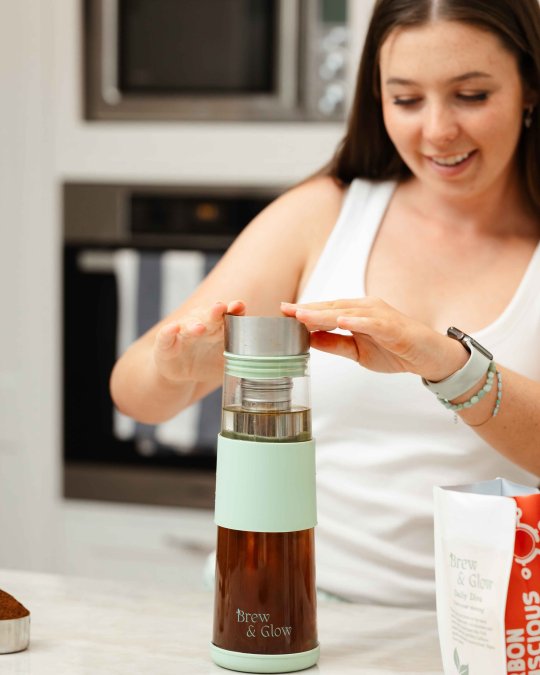
Our top pick for busy people is the Brew & Go Cold Brew Coffee Maker from Brew & Glow, priced at $69.00. It combines double filtration with a smart pour lid, a shock-proof silicone base, and tough borosilicate glass that rinses clean in under a minute. The wide-mouth carafe means you can reach every surface with a sponge, and both the glass and lid are dishwasher safe for those weeks when even rinsing feels like too much.
What most guides miss is the patented cold brew pour mechanism, which delivers clean, sediment-free pouring without a separate filter basket to wrestle with. Customer Monica confirms the difference: "The Brew and Go is genius. Clean, simple and no mess at all."
The one drawback is that the borosilicate glass construction costs more than plastic alternatives. For the durability and the absence of chemical leaching concerns, most users find the premium justified, particularly when the Brew & Go replaces a daily cafe run at roughly $1 a glass.
OXO Cold Brew Maker Alternatives That Save You Time
When you compare cold brew makers against popular two-chamber designs, the conversation usually stops at flavour output and brew strength. What rarely gets discussed is what happens after six months of daily use. The cleaning-first perspective reveals long-term maintenance issues that determine whether your brewer survives the year or ends up in the back of a cupboard.
Filter degradation is the hidden cost of mesh filtration. Most reviews treat a stainless steel mesh filter as permanent. In practice, coffee oils polymerise onto the mesh over time, reducing pore size and slowing flow; a filter that once drained in 30 seconds will take three minutes after six months, and rinsing alone will not restore it. Check whether the manufacturer sells replacement filters and what they cost before you commit. If unavailable, the brewer has a built-in obsolescence of roughly 12 to 18 months.
Hard water scale is the maintenance issue nobody mentions. In hard water areas, mineral scale builds up on the glass carafe and filter mesh, creating a rough surface that traps oils and bacteria. The result is a brewer that looks clean but smells stale, and no detergent will fix it. The solution is periodic descaling with a food-grade citric acid solution: one tablespoon per litre of warm water, left for 30 minutes, then rinsed. Soak the filter mesh for 15 minutes. Do this every four to six weeks with daily use; it takes less than five minutes of active time.
Compact storage solutions for the accessory pile. The fridge footprint problem is not just about the carafe, it is about the filter assembly, stirring spoon, and measuring scoop that come with most brewers. Designate a single drawer or container for all cold brew accessories. Store the filter assembly inside the carafe when not in use to keep it dust-free, so the entire setup is one unit rather than five scattered items.
The two-chamber design trade-off, examined honestly. Brewers with a separate brewing chamber and storage carafe offer the advantage of brewing a concentrate while storing it in a smaller vessel. The maintenance cost is that you clean two vessels instead of one, and the transfer step is where spills happen. The brewing chamber typically has a narrow opening, making it difficult to clean without a bottle brush, and coffee oils accumulate in the threads of the screw-on base. Check whether the brewing chamber is dishwasher safe and whether the filter basket can be fully disassembled. Many cannot, and that is why they end up abandoned.
What to check before buying any cold brew maker:
- Replacement filter availability and cost: If the manufacturer does not sell replacement filters, budget for a new brewer within 18 months.
- Descaling compatibility: Verify that all components can withstand citric acid solutions without degrading. Some plastics become brittle when exposed to acidic solutions repeatedly.
- Accessory storage: Count the total number of components and consider where they will live when not in use. Every loose accessory is a future clutter problem.
- Seal and gasket replacement: The silicone gaskets that create a watertight seal degrade over time. Check whether replacements are available and how much they cost.
A brewer that scores well on these long-term criteria will save you far more time over a year than one that wins on initial cleaning ease. The best cold brew maker for busy people is the one you can maintain in under five minutes per week, every week, for years.
How to Make Cold Brew Coffee at Home in Under 5 Minutes
Making cold brew at home follows a simple ratio: one part coarse grind coffee to four parts cold water, steeped for 12 to 24 hours. The active preparation takes under five minutes.
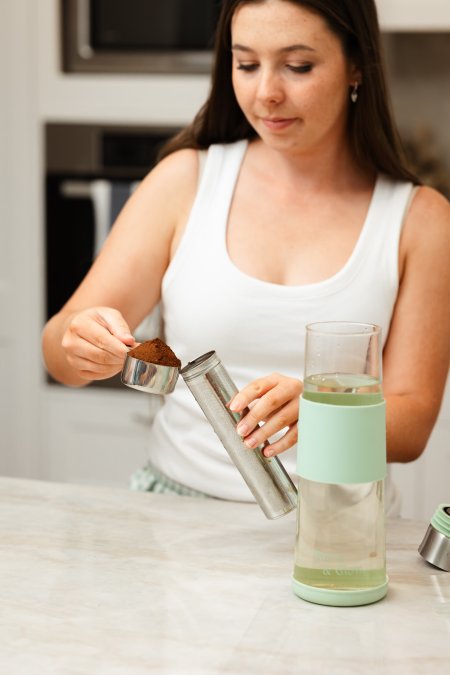
- Add 100 grams of coarse grind coffee to the brewer. A manual grinder set to its coarsest setting works well.
- Pour in 800 millilitres of cold, filtered water, ensuring all grounds are saturated.
- Stir gently with a long spoon to release trapped air.
- Place the lid on and refrigerate for 12 to 24 hours. Longer steeping produces a stronger cold brew concentrate.
- Pour and enjoy. Store the concentrate in the fridge for up to two weeks.
The extraction time is forgiving, which suits busy schedules. Unlike hot brewing, cold water extraction pulls fewer bitter compounds, which is why cold brew naturally carries a smooth flavour profile.
Best Low-Acidity Coffee Beans for a Smooth, Gentle Brew
The best low-acidity coffee beans complement your brewer by delivering a brew that is gentle on sensitive stomachs. Cold brewing itself reduces perceived acidity, but starting with naturally low-acid beans amplifies the effect. Brew & Glow sources responsibly roasted beans, and the Swiss water decaffeination process removes caffeine without chemical solvents for those who want a decaf after dinner.
Customer Alex highlights the difference: "The low acidity really makes a difference... Finally a decaf I can enjoy."
For anyone managing acid reflux or a sensitive stomach, pairing a low-acid bean with cold brewing is the most effective home strategy. Look for beans labelled low acid or processed via the Swiss water method. Dark roasts generally contain less acidity than light roasts, and beans grown at lower altitudes tend to be gentler on the stomach. A coarse grind is essential, as fine grounds clog filters and over-extract.
Conclusion: Choose the Cold Brew Maker That Works as Hard as You Do
The best cold brew maker for busy people is the one that cleans up in under two minutes, because that is the brewer you will actually use tomorrow morning. Prioritise a wide-mouth carafe, a rinse-clean stainless steel mesh filter, and dishwasher-safe parts over aesthetic extras.
Brew & Glow built the Brew and Go around exactly this principle: a patented pour mechanism, double filtration, and borosilicate glass construction that makes mess-free brewing the default. Pair it with responsibly sourced, low-acidity beans and you have a cafe-quality ritual that costs about $1 a glass and takes five minutes of active time per batch.
Get started with Brew & Glow and make tomorrow morning's coffee the easiest part of your day.
Frequently Asked Questions
What coffee maker is the easiest to clean?
The easiest coffee makers to clean are those with few parts, no mesh filters to scrub, and dishwasher-safe components. The Brew & Go cold brew maker is designed for quick rinsing: the borosilicate glass carafe and stainless steel filter rinse clean in under a minute, and the wide mouth lets you reach every corner. You do not need to disassemble multiple pieces or soak parts overnight, making it ideal for busy mornings.
How long does it take to make cold brew at home?
Active preparation takes under five minutes. You add coarse-ground coffee and cold water, stir, and let it steep in the fridge for 12 to 24 hours. The Brew & Go uses a 1:8 ratio to produce a concentrate, so you can dilute it with water or milk. After steeping, you remove the filter basket and the concentrate is ready. Most of the time is hands-off, so it fits easily into a busy schedule.
Is cold brew coffee less acidic than regular coffee?
Yes, cold brew is naturally less acidic than hot-brewed coffee because the cold-water extraction process pulls out fewer acidic compounds. The Brew & Glow products deliver a brew with 70% less acidity for a smoother taste. This makes it gentler on sensitive stomachs while preserving a smooth, sweet flavour profile. For the best results, choose beans roasted specifically for cold brew.


